Remote Work and the Corps

Quick Tip!
All students and staff at the Digital Corps transitioned to remote work in Fall 2020, with some students beginning the transition as early as Spring 2020.
Helpful Staff for this Topic


We live in a technologically advancing society. The way we interact with others changes drastically from year to year. With the widespread use of cell phones and computers, the way we communicate now differs greatly from that of 100 years ago. To this point, the way we interact within the workforce has changed as well. Many companies have made the shift to remote work. According to a 2018 Global Workplace Analytics Report, “5 million employees (3.6% of the U.S. employee workforce) currently work-at-home half-time or more.” The shift to remote work, full or partial, is widespread in the U.S.. Due to the events of 2020, staff and students at the Digital Corps joined the remote workforce through a hybrid on-campus and at home work experience.
To comply with University directives, the Digital Corps introduced several remote work practices, and each of our teams––Design, Video, Development, Communication, User Experience, and Project Management––have adjusted to this change in a variety of ways. For the Project Management team, the addition of remote work has presented several new opportunities for learning and growth. Like the Digital Corps, many companies have reconfigured their work environment and left the familiar confines of office buildings for home offices, living rooms, and bedrooms. DeveloperTown, a company in Indianapolis that shares several characteristics with the Digital Corps, also adapted to the changing environment.
Remote Work in the Industry
DeveloperTown is a creative agency that works to “leverage technology to drive growth,” support clients and their visions, and promote collaboration and innovation within the workplace. Similar to the Corps, their employees specialize in a variety of fields, including design, user experience, and development, and they collaborate within these teams to fulfill their overarching mission. Along with many others in the tech industry, DeveloperTown transitioned from a company with some employees who worked remotely to a fully remote workforce. While this change was not as jarring for some employees, DeveloperTown had to implement several new changes to their workspaces, communication processes, office culture, and management.
Remote Workspaces at DeveloperTown
DeveloperTown has a unique setup when it comes to in-person workspaces. Each employee has their own “house” that functions as an office space, in addition to community tables for collaboration and discussion.
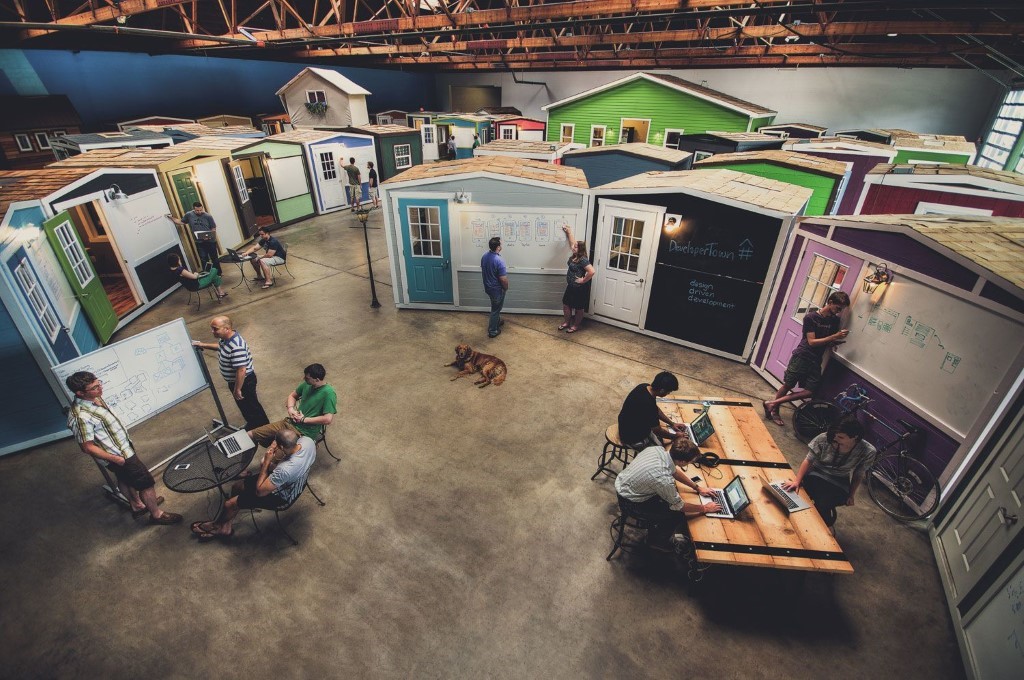
With the transition to remote work, employees have lost those elements of their workspaces. Hiring manager Jen Burkus noted that while the transition to remote work was relatively easy, it was essential for her to maintain productivity among teams and help keep spirits high.
“Driving engagement can be difficult,” says Burkus. “At DeveloperTown, our physical facility is an important part of our workplace––when you’re taken out of the physical facility, you feel like that aspect is lost. We’ve had to ensure that we keep engagement high!”
Burkus cited the dedication of hiring managers and a variety of social aspects that evolved within the DeveloperTown community as key factors in maintaining productivity during a time when motivation could dwindle. To facilitate the sense of community normally felt within the office as they moved online, the element of a dedicated workspace was reinforced with more connection and communication among employees.
Communication within DeveloperTown
With the transition to fully remote work comes the need for greater communication. Burkus described the importance of virtual messaging and seeing the faces of her fellow employees.
“Slack is our inter-office communicator,” said Burkus. “Channels allow us to be specific with topics and projects, which is helpful for communication. We also use Zoom and Google Meet for video conferences.”
Burkus emphasized the benefits of when her coworkers turn their cameras on––it allowed for a more personal connection and improved overall communication when team members could see one another. In addition to their increased virtual communication, DeveloperTown made efforts to replicate their office culture and community.
Office Culture within DeveloperTown
To facilitate the openness and collaborative nature of in-office functions remotely, DeveloperTown added more social elements to their existing communication methods.
“We’ve created some new Slack channels and events which have allowed us to learn more about each other on a personal level.”
Those additional social experiences sought to simulate the atmosphere of the workplace while employees worked remotely and allowed coworkers to learn more about one another. It was important for the management at DeveloperTown to embrace this extension of the office culture as they helped foster the changes in communication.
Management within DeveloperTown
At DeveloperTown, the management team, also known as engagement managers, function as business analysts and quality assurance testers, along with other project responsibilities. They enacted daily scrum meetings, or quick check-ins with the project team, to ensure that they understood their tasks and responsibilities for the project. With the transition to fully remote work, however, they adjusted how they led those meetings.
“We try to collectively get together as a company once a month for an all-hands team meeting,” said Burkus. “This is typically when we hear from the leaders of the organization. We’ve also been doing more check-ins with employees––hiring managers will have weekly one-on-ones with them.”
The “all-hands” team meetings became more frequent as they transitioned to remote work––as did the check-ins. The management at DeveloperTown has worked to maintain high engagement among the employees and reinforce the sense of value in their efforts.
Throughout the transition to remote work, DeveloperTown was committed to ensure employees felt connected, valued, and engaged. Like DeveloperTown and other industry professionals, the Digital Corps followed a similar path during the shift to remote work in 2020.
Remote Work at the Corps
At the Digital Corps, employees transitioned from a fully on-campus work environment to a hybrid system of in-office and remote work. This was a dramatic change from the traditional in-office approach, but employees used the opportunity to learn new skills and prepared themselves for the workplace. They adjusted to remote workspaces, found ways to maintain Corps culture away from campus, and learned to communicate remotely.
Remote Workspaces within the Corps
Employees at the Digital Corps work remotely primarily from their dorms and apartments in Muncie or from their hometowns. With the transition to remote work, Corps employees had to adapt their surroundings to create dedicated workspaces. Hailey Leonard, a User Experience Specialist, had a different remote work experience. She worked remotely in her hometown two hours from Muncie. She described the adjustments she had to make regarding her workspace. “There are different types of distractions at home,” said Leonard. “In the office you want to talk to people, at home your bed is right next to you! It’s all about managing a different type of distraction.”
The remote work experience pushed her to improve her self-motivation and find a space that was uniquely hers. Madison Sherrick, a Design Team Master, shared Leonard’s sentiments.
“Not everyone has the same quality of life when it comes to remote work, so there are differences there. But everyone has a desk, and everyone is trying to make their space work.”
They emphasized that while each employee’s situation is different, everyone wanted to make their space conducive for remote work.
Communication within the Corps
Communication among coworkers is essential at any workplace, and the transition to remote work increased the need for clearer and more consistent communication. Through the remote work transition, Digital Corps employees had to improve upon their existing communication skills and adapt them to a remote environment. Before the transition to remote work, employees used Slack to communicate and collaborate on projects. With the shift, it played a more critical role for remote communication. Nick Kampsen, a Video Team Specialist, often used the direct message feature within Slack to stay in touch with team members.
“Direct messages are more personal,” says Kampsen. “When I send someone a DM, it’s like I’m talking to them; they have to respond.”
Along with Kampsen, Leonard also used Slack for remote communication. She made sure to message and call her coworkers on Slack, as well as post in the channel to keep her teammates updated. In addition to increased communication, employees at the Digital Corps added elements of socialization to ensure that the retained the uplifting distinctive Corps office culture is still present, even remotely when they were away from the office.
Office Culture within the Corps
Although Corps employees were no longer physically together, they actively participated in socialization events to stay connected. Sherrick described their socialization efforts as a Master, and their involvement in All Corps meetings.
“We’ve had to be more creative when implementing Master projects and tasks,” said Sherrick. “We try to make All Corps fun and keep people engaged; we’ve had to be really creative to do so.”
These thoughts were emphasized by Addison Paul, a Communication Master, who described the socialization efforts within Slack.
“The Corps is a socially buzzing, bustling environment,” said Paul. “Slack is always virtually bustling. It’s an excellent resource for socialization––we have a lot of fun social channels!”
To promote socialization among the employees, new Slack channels were created. For example, in the Social Shenanigans channel, weekly prompts encouraged Corps employees to join in the fun and find out what their coworkers were up to. Corps Olympics was another socialization channel developed for greater connection within the Corps. Student employees were put on teams and could participate in weekly challenges that earned them points, with an eventual winner at the end of the semester. While not the same as in-office socialization, these efforts taken by Corps employees allowed for greater connection and conversation during remote work. Along with this, the Project Management Team at the Digital Corps took extra steps to ensure proper communication and socialization across all teams.
Management within the Corps
The Project Management Team worked closely with staff and students to maintain effective and meaningful communication across the organization. Slack was an important part of these efforts, as was Zoom for weekly 30-minute project meetings. Check-ins within project channels became more frequent, as well as direct communication with JPMs (Junior Project Managers) to ensure steady progress. Lauren Monasa, a Project Management Apprentice detailed her experience as she transitioned to remote work.
“It’s certainly been a challenge, but overall, I think the PM team has been working really hard to ensure that everyone is feeling comfortable and confident about the direction of projects,” said Monasa. “We’ve really been utilizing Slack and Zoom to connect with people and make sure everyone is on the same page.”
The transition to remote work called for this increase in direct communication from both PM members and team members, but the PM team took the extra steps needed to guarantee that employees made progress towards project completion.
Remote Work as an Organization
Overall, students and staff at the Digital Corps embraced the opportunity for growth during their remote work experience. When comparing the approach of DeveloperTown to that of the Digital Corps, several similarities emerged: increased communication, socialization, respect for workspaces, and involvement of Project Managers. The Digital Corps was not alone in this transition or making it in a productive way. Communication Master Addison Paul described her gratitude for the experience.
“The Digital Corps has opened up opportunities for me in the remote work world,” said Paul. “I’m glad I have this experience going into the industry.”
The success of the Corps’ remote work transition was due to the initiative of employees and support from the staff. Together, the Digital Corps allowed employees to gain industry knowledge and hone their skills for the workforce.
